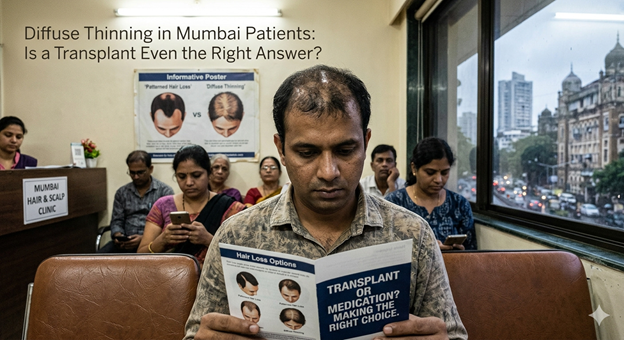
Diffuse Thinning in Mumbai Patients: Is a Transplant Even the Right Answer?
Many patients who visit a hair specialist in Mumbai describe the same experience: they’re not going bald in one spot, but their hair overall just looks thinner. Parting lines appear wider. Ponytails feel lighter. Scalp shows through under certain lighting. This kind of gradual, all-over thinning — known as diffuse thinning — is different from typical pattern baldness, and yet many patients wonder if a hair transplant is still the answer. The honest response is: sometimes yes, but often no — and understanding why requires looking at what’s actually happening beneath the surface.
What Diffuse Thinning Actually Means
Diffuse thinning refers to a generalised reduction in hair density across a large portion of the scalp, rather than concentrated loss in a specific area like the crown or hairline. The hairs don’t disappear entirely; they miniaturise. Over time, thick, pigmented terminal hairs gradually convert into fine, short, barely visible vellus hairs due to disruption in the hair growth cycle.
This is a key distinction. In typical androgenetic alopecia, there’s often a stable donor zone at the back of the scalp — an area unaffected by the hormone DHT — which surgeons can use as a reliable source for transplantation. In diffuse thinning, this donor zone may also be compromised, making transplant planning significantly more complex.
Why Mumbai’s Environment and Lifestyle Play a Role
Mumbai’s specific conditions add layers to this problem that aren’t always discussed. Patients dealing with diffuse thinning in this city often have multiple contributing factors running simultaneously:
- Chronic stress from long commutes, work pressure, and urban living
- Hard water exposure, which affects scalp barrier health over time
- Heat and humidity creating conditions that favour scalp inflammation
- Dietary patterns that may be low in iron, vitamin D, or biotin
- Hormonal fluctuations, particularly common in women after pregnancy or during perimenopause
These triggers can cause or worsen telogen effluvium — a condition where a large number of hairs shift into the resting (shedding) phase at once. Unlike genetic thinning, telogen effluvium is often reversible once the root cause is addressed.
When a Transplant May Not Be Appropriate
This is where many patients receive incomplete guidance. A hair transplant works by relocating healthy follicles from a stable donor area to a thinning recipient area. For this to be effective, two conditions need to be true: the donor area must have adequate, healthy hair, and the underlying cause of thinning must be stable or resolved.
In cases of active diffuse thinning — where hair loss is still ongoing — transplanting follicles into an unstable environment may yield disappointing results. The transplanted hairs may survive, but surrounding native hairs may continue to thin, creating an uneven outcome that requires further intervention.
Additionally, if the cause is nutritional deficiency, thyroid dysfunction, or stress-related shedding, addressing the medical root cause may lead to significant natural regrowth without any surgical intervention at all.
Non-Surgical Options That May Be Considered First
Before any surgical decision is made, a thorough evaluation often reveals treatment paths that don’t involve a transplant:
- Low-level laser therapy (LLLT) to stimulate miniaturised follicles
- Platelet-rich plasma (PRP) injections to support the follicular environment
- Topical or oral medications to slow ongoing loss and support regrowth
- Nutritional correction through targeted supplementation
- Scalp treatments to manage inflammation or seborrheic conditions
These approaches are not substitutes for surgery in all cases — but for many patients with diffuse thinning, they represent a more appropriate first step that can produce meaningful improvement.
How the Right Evaluation Changes the Treatment Path
The quality of the initial assessment matters enormously. Clinics like Kibo Clinics focus on evaluating the underlying cause before recommending a treatment direction — which means some patients are guided toward medical management first, and only considered for surgical options once their condition is stable and their candidacy is properly assessed.
This kind of structured evaluation helps patients avoid premature procedures and sets more realistic expectations for outcomes.
Final Thoughts
Diffuse thinning can be frustrating precisely because it’s subtle — it creeps up slowly and doesn’t always respond to the same solutions as other forms of hair loss. For Mumbai patients dealing with this pattern, the most important first step is an accurate diagnosis. A transplant may eventually be part of the plan, but it’s rarely the right starting point. Understanding the cause of thinning, stabilising it where possible, and then reviewing surgical options — in that order — tends to lead to better long-term outcomes.