
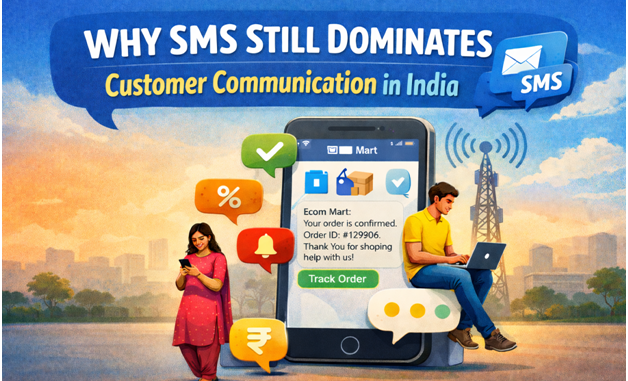
We live in a time where our thumbs are constantly scrolling through Instagram reels, and our family groups on WhatsApp are always buzzing. It is easy to assume that the humble SMS (Short Message Service) is a thing of the past. After all, who sends a “text” to a friend anymore?
But here is a reality check. When you want to log into your bank account, what do you wait for? An OTP. When your Amazon delivery is at the doorstep, how do you know? You get a text. When your salary is credited, what brings that smile to your face? A simple SMS notification.
In the flashy world of modern apps, SMS is the silent workhorse that still remains the undisputed king of business communication in India.
1. The “No Internet” Advantage
This is the biggest reason for SMS’s survival. India has cheap data, but it does not have perfect connectivity. We all face network drops in basements, elevators, or while travelling on highways. Millions of users in Tier-2 and Tier-3 cities often turn off their mobile data to save battery or money.
SMS does not care if you have 4G, 5G, or no ‘G’. It works on the basic cellular signal (GSM). For a business, this is crucial. If you send a WhatsApp message or an email, it might sit unread for hours until the user connects to the internet. An SMS lands instantly. This reliability is why businesses prefer partnering with established SMS providers in India to ensure their message is delivered, regardless of anything.
2. Unmatched Reach (Feature Phones Matter)
According to recent data from TRAI (Telecom Regulatory Authority of India), the total wireless subscriber base in India is over 1.16 billion. However, a significant chunk of this population still uses feature phones (keypad phones).
These users do not have apps. They do not have social media. The only way a brand can reach them digitally is through a text message or a voice call. By ignoring SMS, businesses risk ignoring a massive portion of the Indian market. SMS is the only channel that offers 100% compatibility with every mobile device manufactured in the last two decades.
3. The Higher Open Rate Phenomenon
Now, let’s talk about attention span. If you send an email marketing campaign, a 20% open rate is considered a success. Most emails end up in the “Promotions” tab or spam folder. Social media posts have an even lower organic reach.
SMS, on the other hand, demands attention. Studies consistently show that SMS has an open rate of nearly 98%. Even more impressive is the speed: 90% of text messages are read within three minutes of delivery. In India, the “ping” of an SMS creates a sense of urgency. We are conditioned to check it immediately because we assume it is important information – like a bank alert or a service update.
4. The Backbone of Critical Alerts
In India, SMS is not just for marketing; it is a utility. The entire digital payment infrastructure, including UPI, relies on the speed of SMS.
This is where a dedicated Transactional SMS service comes into play. These are non-promotional messages used for sending OTPs, booking confirmations, order tracking, and bank alerts. Because these messages are time-sensitive (imagine waiting 5 minutes for an OTP!), they are routed through priority channels to ensure instant delivery. Without this infrastructure, online trust would crumble.
5. Trust and Regulation (The DLT Effect)
A few years ago, spam was a major headache. Inboxes were full of unsolicited real estate and loan offers. To fix this, the Indian government introduced DLT (Distributed Ledger Technology) regulations.
Now, every business must register their entity, sender identity (sender ID) and messages (SMS templates). When you receive a message from “IP-HDFCBK” or “BZ-ZOMATO,” you know exactly who it is from. This verification has cleaned up the ecosystem. It has restored consumer trust. People now know that a branded SMS is likely legitimate, unlike a random WhatsApp message from an unknown number which feels intrusive or suspicious.
6. It Breaks the Language Barrier
India speaks many languages. English works in metro cities, but what about the rest of the country? SMS supports Unicode, which allows businesses to send messages in Hindi, Tamil, Telugu, Marathi, and other regional languages.
A farmer in rural Maharashtra is far more likely to respond to a Marathi text about crop prices than an email in English. This ability to localize content makes SMS a powerful tool for building a personal connection.
7. Affordable and Scalable for Indian Businesses
Marketing budgets in India are often tight, especially for small and medium enterprises. TV, print, and large digital campaigns can be expensive.
SMS, on the other hand:
- Has low cost per message
- Scales easily from hundreds to lakhs of customers
- Requires no creative design or heavy content
A clear 160‑character message can do the job. Whether it is a retail sale, a clinic reminder, or a coaching class alert, SMS offers a simple and affordable way to stay in touch with customers.
This cost‑effectiveness is a big reason why even local businesses choose bulk SMS as their primary communication tool.
Conclusion
New technologies like RCS and WhatsApp maybe keep coming. Chatbots and AI are exciting, but they often require complex setups and internet access. SMS remains simple, direct, and universally accessible.
For any business looking to communicate effectively in India, the strategy is simple: Use social media for engagement, but use SMS for action. It is the only channel that guarantees your voice reaches the customer’s pocket, instantly and reliably.