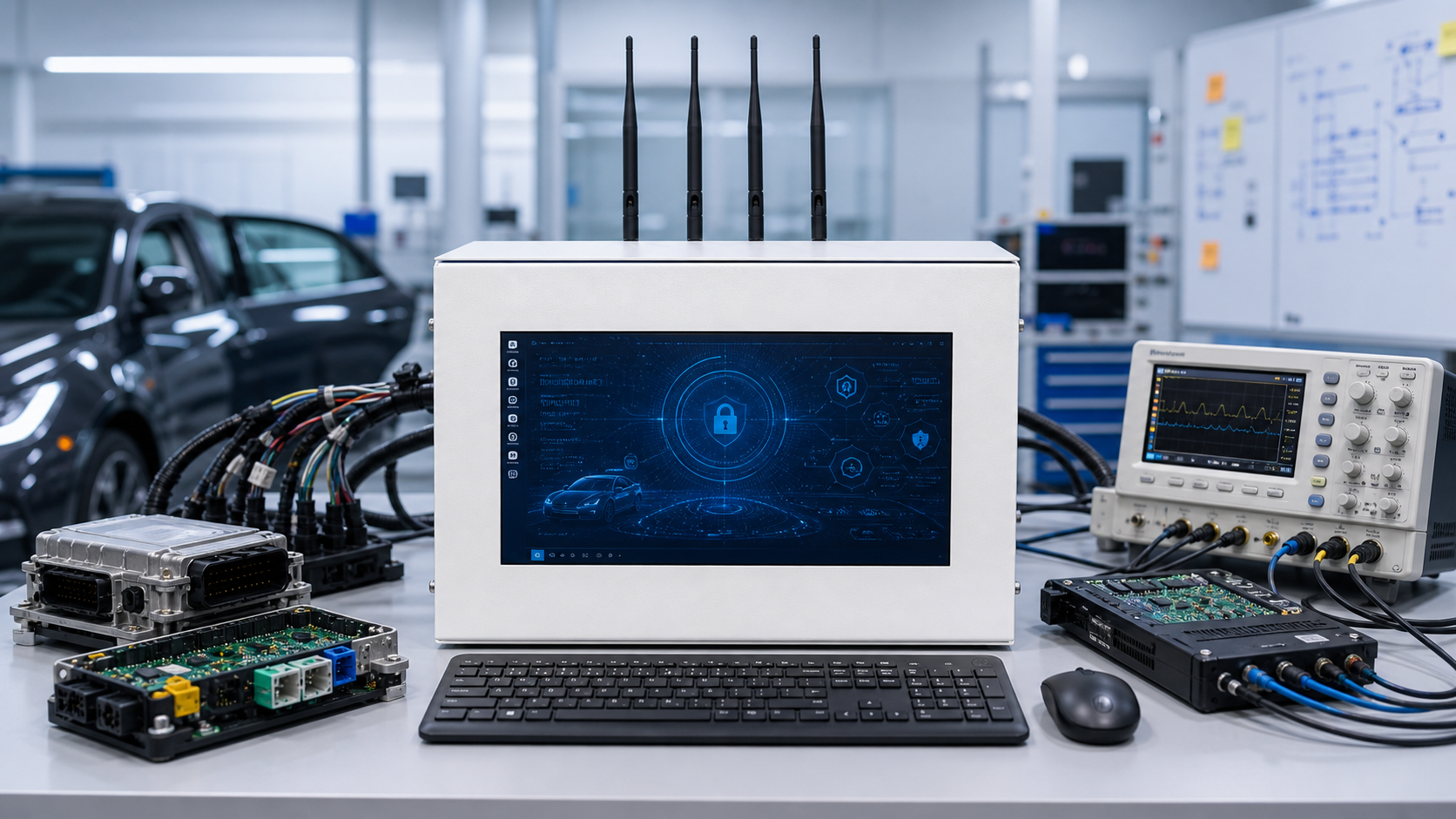
HackersEra’s Cyber Resilience Lab shows how India can test and secure the next generation of software-defined vehicles.
PUNE, June 9, 2026: For decades, vehicle safety was understood through visible tests: crash impact, braking performance, airbags, seatbelts, emissions and roadworthiness. But the modern car is no longer only a mechanical product. It is also a connected computer on wheels, with software, sensors, wireless systems, charging interfaces, mobile apps and cloud-linked services working together every second.
That change is creating a new safety requirement for the automotive industry: cyber resilience. In simple terms, a vehicle should not only perform well on the road. It should also be able to resist, detect and respond to digital risks throughout its life.
This is where automotive cyber resilience labs are becoming important. These labs give OEMs, suppliers and testing bodies a controlled environment to validate how a vehicle’s digital systems behave before they reach customers. The idea is not to create panic around connected cars, but to make the technology more trustworthy.
Pune-based HackersEra Automotive Cybersecurity Pvt. Ltd. is among the Indian companies building this capability. Its Automotive Cyber Resilience Lab is already in the market and is being positioned for wider use across vehicle manufacturers, Tier-1 suppliers, testing laboratories, homologation environments and regulatory-readiness programs.
Why Cars Now Need Cyber Testing
Today, a vehicle may include telematics, digital keys, Bluetooth, Wi-Fi, cellular connectivity, over-the-air software updates, EV charging communication, infotainment, ADAS sensors and several electronic control units. These systems improve comfort, safety and efficiency, but they also create more points that need careful security testing.
Global automotive regulation is also moving in this direction. UN Regulation No. 155 deals with vehicle cyber security and cyber security management systems, while UN Regulation No. 156 focuses on software updates and software update management systems. ISO/SAE 21434 has become an important engineering standard for cybersecurity across the road vehicle lifecycle.
For Indian automotive companies, this shift comes at an important time. India is scaling electric vehicles, connected mobility, software-defined vehicle programs and exports. As a result, cybersecurity is becoming part of product quality, brand trust and regulatory readiness.
What A Cyber Resilience Lab Does
A cyber resilience lab is similar in spirit to a vehicle testing center, but its focus is digital systems. Instead of testing only physical durability, it helps engineering teams examine how electronic and software systems behave under controlled cybersecurity validation.
HackersEra’s lab approach covers both vehicle-level and component-level testing. It includes in-vehicle networks such as CAN, CAN-FD, LIN, FlexRay and Automotive Ethernet; external interfaces such as Wi-Fi, Bluetooth, BLE, NFC and USB; RF systems such as key fob, TPMS and GNSS; cellular connectivity; V2X communication; EV charging infrastructure; embedded hardware; firmware; side-channel exposure; and ADAS-related systems.
For a non-technical reader, this means the lab checks the digital doors through which a vehicle communicates with the outside world: phones, charging stations, cloud platforms, other vehicles, roadside infrastructure, service tools and internal electronic modules.
“Automotive cybersecurity cannot remain a last-minute checklist. It has to become part of engineering validation, just like safety, quality and reliability,” said Vikash Chaudhary, Founder and CEO of HackersEra. “Cyber resilience labs help teams create repeatable evidence that a vehicle’s connected systems have been properly tested.”
From One-Time Audit To Continuous Readiness
One of the biggest changes in the auto industry is that vehicle software keeps changing after sale. Over-the-air updates, connected services, fleet monitoring and app-based features mean the vehicle lifecycle continues long after it leaves the factory.
This makes one-time security assessments insufficient. A vehicle may be tested before launch, but new software, new features, supplier updates and changing threat conditions can create fresh risks later. Cyber resilience means preparing for this reality in a structured way.
HackersEra says its broader automotive cybersecurity work spans compliance automation, vehicle security operations, in-vehicle protection, penetration testing, security testing tools and lab infrastructure. The company says it has worked with more than 25 OEM clients across seven countries, completed more than 600 projects and tested over 200 ECU models.
The Cyber Resilience Lab fits into this larger shift from services alone to permanent testing infrastructure. For OEMs and suppliers, such labs can support product validation, internal team training, compliance evidence and faster response to cybersecurity findings.
India’s Opportunity In Vehicle Cybersecurity
India has a unique opportunity in this space. The country already has a large automotive manufacturing base, a strong engineering workforce and a growing electric mobility ecosystem. If cybersecurity testing capability is built early, India can become not just a vehicle production hub, but also a vehicle security validation hub.
This matters for both domestic and export markets. Indian vehicle makers and suppliers increasingly serve global platforms where cybersecurity expectations are rising. Testing infrastructure built in India can help local companies prepare for international requirements while keeping costs practical for Indian business realities.
Chaudhary believes India should look at automotive cybersecurity as an opportunity, not only as a compliance burden. “Indian engineering talent has the ability to build advanced vehicle security capability. The important thing is to move early, build deep technical infrastructure and make cybersecurity part of the product development culture,” he said.
What This Means For Vehicle Owners
For consumers, this development should be reassuring. Connected vehicles are not going away. Digital keys, connected apps, EV charging, navigation, software updates, ADAS and smart fleet services are becoming normal parts of mobility.
The right response is not to fear connected technology, but to test it responsibly. Just as crash testing made vehicles safer over time, cybersecurity testing can make connected vehicles more reliable and trustworthy.
As mobility becomes more digital, cyber resilience may become one of the pillars of vehicle safety. Companies that invest in this capability early will help define how India builds trust in the next generation of connected, electric and software-defined vehicles.