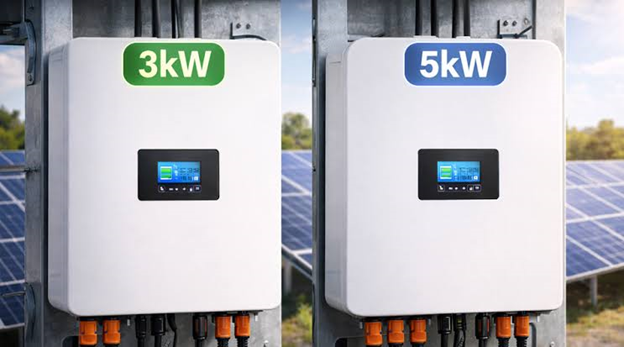
How often do homeowners outgrow their electricity needs without noticing it? A home that once relied on a few essential appliances may now support remote work, longer cooling hours, and a growing list of connected devices. As solar adoption becomes more common, choosing the right system size has become just as important as deciding to go solar in the first place.
Many buyers begin their research with a hybrid solar inverter of 3kw because it appears suitable for typical residential use. Yet capacity decisions are rarely that straightforward. A system that meets today’s needs may feel limiting a few years later, while an oversized system may not always be necessary.
Understanding the difference requires looking beyond simple power ratings. Let’s understand how they work and which one would be the most suitable for modern homes.
Understanding the Difference Between 3kW and 5kW Hybrid Solar Inverters
The right inverter capacity depends on how a household consumes electricity today and how those needs may evolve in the future. Looking beyond upfront costs often leads to a more practical long-term decision.
- Why a Hybrid Solar Inverter of 3kW Can Be the Right Choice
- Suitable for small and medium-sized households with moderate daily electricity consumption.
- A hybrid solar inverter of 3kw can efficiently support essential appliances such as fans, lights, refrigerators, televisions, and laptops.
- Combines solar power generation with battery-backed backup to provide greater energy reliability.
- Helps reduce reliance on grid electricity while making better use of solar energy produced during the day.
- Requires comparatively less roof space, making it practical for homes with installation limitations.
- Supports uninterrupted power availability during outages when connected to a compatible battery system.
- Aligns well with homeowners seeking a system that matches current energy needs without unnecessary excess capacity.
- Can contribute to lower electricity expenses through increased solar self-consumption.
- Offers a balanced approach between upfront investment and long-term energy benefits.
- Provides flexibility for households looking to combine power savings with dependable backup support.
- When Does a 5kW Hybrid Solar Inverter Make More Sense?
- A 5kW hybrid solar inverter is often better suited to larger households with higher daily electricity requirements.
- Supports increased energy demand from multiple air conditioners, larger kitchen appliances, water pumps, entertainment systems, and home office equipment.
- Provides additional capacity for homes where electricity consumption is consistently higher throughout the day.
- Can accommodate future lifestyle changes, including the addition of new appliances or increased household occupancy.
- Reduces the need for capacity upgrades as energy requirements grow over time.
- Offers greater flexibility for families planning for long-term electricity needs rather than current usage alone.
- Better suited for households that expect seasonal spikes in power consumption, particularly during warmer months.
- Supports broader backup requirements during power cuts, allowing more appliances to remain operational.
- Helps homeowners prepare for evolving energy demands without having to redesign their solar setup later.
- Can provide stronger long-term value for households seeking a balance between energy independence, backup capability, and future readiness.
Hybrid Solar Inverter 3kW vs 5kW: A Side-by-Side Comparison
The choice between a hybrid solar inverter of 3kw and 5kW system becomes easier when viewed through practical household requirements rather than technical specifications.
| Factor | Hybrid Solar Inverter 3kW | Hybrid Solar Inverter 5kW |
| Household Size | Small to medium households | Medium to large households |
| Daily Energy Demand | Moderate | Higher |
| Appliance Usage | Essential and everyday appliances | Everyday appliances plus higher-load equipment |
| Roof Space Requirement | Lower | Higher |
| Initial Investment | Lower | Higher |
| Future Expansion Potential | Suitable for stable consumption | Better for growing energy needs |
| Backup Expectations | Supports essential backup requirements | Supports broader backup requirements |
| Long-term Flexibility | Good for predictable usage | Better for changing lifestyles |
The comparison highlights an important point. A hybrid solar inverter of 3kw is not automatically the better choice because it costs less, and a 5kW system is not automatically the better choice because it offers more capacity.
Ready to Choose the Right Hybrid Solar Inverter Capacity?
The difference between a hybrid solar inverter of 3kw and 5kW system comes down to how a household uses electricity today and how those requirements may evolve over time. A hybrid solar inverter of 3kw often suits homes with moderate energy consumption and stable usage patterns, while a 5kW system can provide additional capacity for larger families or properties with growing power requirements.
A successful solar investment looks beyond present-day electricity consumption. Factors such as future appliance additions, backup power expectations, roof space availability, and incentives available under the PM Surya Ghar Yojana can all influence long-term outcomes.
While evaluating solar options, it can be useful to look at energy solution providers such as Eastman Auto and Power Limited that offer integrated systems combining hybrid inverters, solar panels, and battery storage. Considerations like a 10-year warranty on hybrid inverters, along with 24×7 service support and a 2-hour service response commitment, may help homeowners assess long-term reliability beyond system capacity alone. Looking at these factors together can make it easier to identify a solar solution that aligns with both current requirements and future energy goals.