
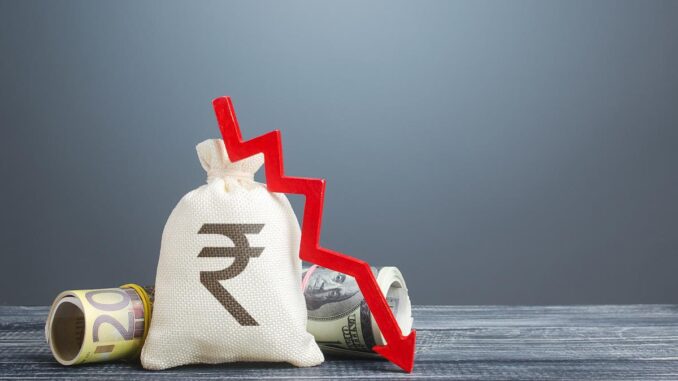
This article is written by Dr. Ratish Gupta, Director at Wealth Wisdom India Pvt Ltd (WWIPL.com)
The Indian rupee has slid to an unprecedented low, breaching the ₹91 level against the US dollar for the first time on Tuesday, December 16, 2025, marking a fresh chapter in its ongoing depreciation this year. Markets saw the currency trading around ₹91.07, extending a pronounced downtrend that has persisted through several months of external pressures and investor caution. The slide to this historic level underlines deepening concerns among traders and economists about external economic headwinds, continued foreign portfolio outflows, and lingering uncertainty over key trade negotiations with the United States — India’s largest export destination.
Multiple Sessions of Historic Lows
In the days preceding the breach of the 91 mark, the rupee had already hit several all-time lows, underscoring the intensity of the downward momentum. On December 15, the currency touched around ₹90.74 and ₹90.73 in intra-day trade before settling weaker, reflecting sustained pressure from external forces and risk-off sentiment among global investors.
Analysts say the frequency of new record lows — now not a single-day anomaly but a sequence of declining levels — highlights the market’s struggle to find firm support amid disappointing capital flows and trade concerns.
Drivers of the Rupee’s Decline
Several key factors have converged to weaken the rupee this year:
- Persistent Foreign Capital Outflows: Foreign institutional investors (FIIs) have been continuously withdrawing capital from Indian equities and bonds throughout 2025. The cumulative sell-offs have put sustained downward pressure on the currency by increasing demand for US dollars as investors repatriate funds.
- Uncertainty in US-India Trade Talks: The absence of a conclusive trade agreement with the US has amplified market anxiety. Tariffs imposed by the US on Indian goods and the delayed progress in bilateral trade negotiations have weighed heavily on investor sentiment, affecting both export prospects and foreign investment flows.
- High Dollar Demand and Hedging: Importers — particularly in sectors such as oil and precious metals — have stepped up demand for dollars to hedge future exposures, which exacerbates downward pressure on the rupee. This has been especially acute given India’s heavy reliance on dollar-denominated imports like crude oil.
- Current Account and Trade Deficit Pressures: A widening trade deficit in recent months, resulting from stronger import demand relative to export receipts, has kept pressure on foreign exchange markets. Analysts note that elevated import costs — from energy to intermediate goods — combined with slow export growth, have pushed up the current account deficit, increasing the supply of dollars required.
- Risk-Off Global Sentiment: Broader shifts in global risk appetite have driven investors towards safe-haven assets like the US dollar, making emerging market currencies such as the rupee more vulnerable.
Taken together, these elements have created a prolonged imbalance between dollar supply and demand in India’s foreign exchange markets.
Implications for the Economy
A weakening rupee has tangible macroeconomic consequences:
- Import Costs and Inflation: As the rupee loses value, it takes more rupees to buy dollars for imports — particularly crude oil, the price of which accounts for a significant share of India’s import bill. This can feed into domestic fuel costs and broader inflation.
- Trade Competitiveness: While a weaker currency can, in theory, make Indian exports more competitive by lowering prices abroad, the current slump has been driven by non-structural factors that may not translate into export gains. Unresolved trade barriers and tariffs limit the potential benefits of currency depreciation.
- Capital Market Sentiment: Continued foreign equity and debt outflows can dampen investor confidence and impact valuations in domestic capital markets, potentially slowing broader economic activity.
Reserve Bank of India (RBI) Role
The Reserve Bank of India has been active in moderating volatility in the foreign exchange market, intervening through dollar sales and other liquidity measures to cushion sharp falls. However, the scale of intervention has been calibrated, balancing the need to preserve reserves against the risk of aggressive defence at specific exchange rate levels.
Market participants point out that while RBI actions have at times slowed the pace of depreciation, the currency remains under sustained downward pressure on flow-driven fundamentals.
Outlook and Market Expectations
From an analytical standpoint, the rupee’s near-term direction is likely to remain closely tied to three interrelated forces: the progress of India–US trade negotiations, the behaviour of foreign portfolio investors, and broader movements in the US dollar driven by global risk sentiment. In the absence of a meaningful breakthrough on the trade front or a decisive reversal in foreign capital flows, the currency may continue to trade under pressure. While episodic support from the Reserve Bank of India can help smooth excessive volatility, such interventions are unlikely to reverse the trend unless supported by improved external flows. A sustained return of foreign investment, combined with clarity on trade policy and tariff issues, could help stabilise the rupee and prevent a prolonged phase of depreciation. Looking ahead, if current structural and external challenges persist, the possibility of further weakness extending into 2026 cannot be ruled out. However, this outlook is not immutable. Stronger export performance, narrowing of the trade deficit, or coordinated policy measures could alter market expectations and provide the rupee with a more durable anchor. In that sense, the currency’s future path will reflect not just global conditions, but the effectiveness of India’s policy response to an increasingly complex external environment.